
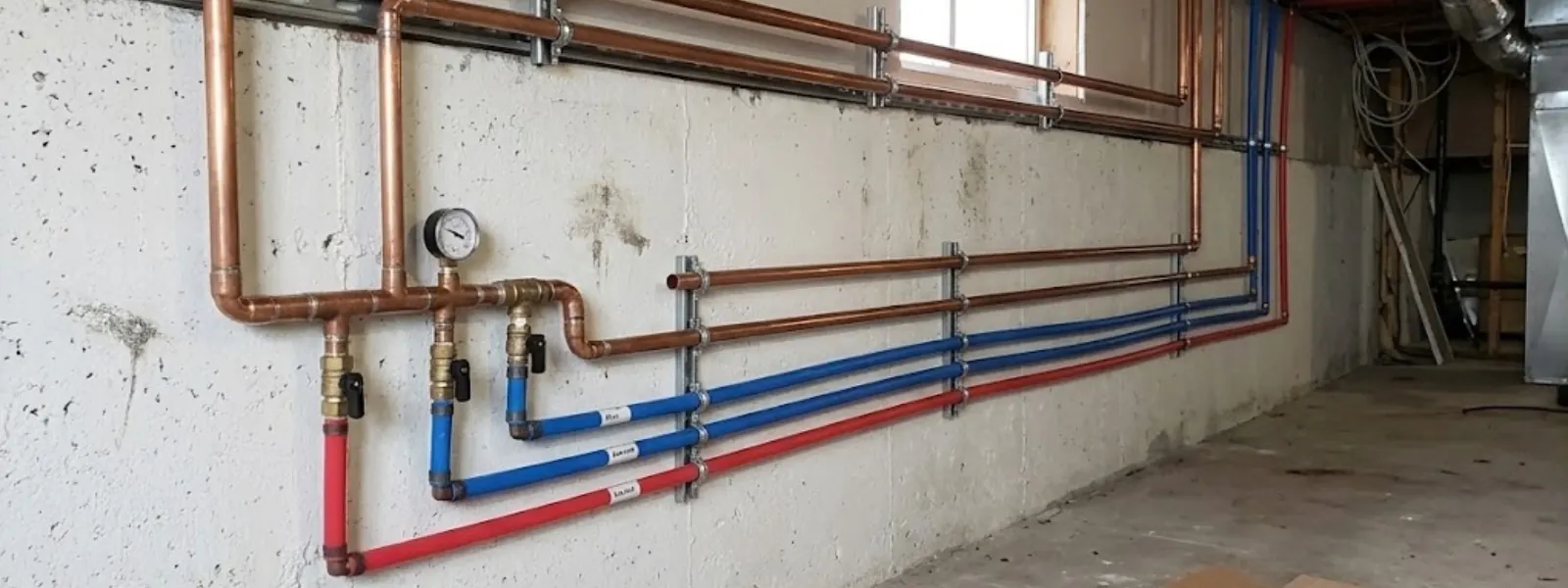
Copper tubing is still one of the most common materials for water supply lines in houses built from the mid twentieth century onward. A copper line that is well installed and well matched to its water can run for decades. The trouble is that copper fails in a few predictable ways, and recognizing them early turns a ruined ceiling into a small repair.
Types K, L and M: what the letters mean
Rigid copper comes in three wall thicknesses. The letter tells you the thickness, and the thicker the wall, the more it costs and the longer it tends to last.
| Type | Wall | Where it is used |
|---|---|---|
| K | Thickest | Buried service lines and the toughest jobs |
| L | Medium | The usual choice for interior supply lines |
| M | Thinnest | Lighter-duty interior runs in many older and budget builds |
Soft copper coil is also used outdoors and for some appliance connections. It bends without fittings, but it kinks if you push it too far.
How copper compares with the alternatives
| Material | Strengths | Weaknesses |
|---|---|---|
| Copper | Long life, handles heat, familiar to every plumber | Can pit or pinhole, costs more, solder joints take skill |
| PEX | Flexible, quick to install, tolerates freezing better | Can be damaged by sunlight, not for every location |
| CPVC | Inexpensive, no corrosion | Brittle with age, can crack at fittings |
| Galvanized steel | Found only in older homes | Rusts from inside, restricts flow and is usually replaced |
No material wins everywhere. Copper often remains the better pick for exposed runs, the water heater connections and any place where heat and durability matter. PEX makes sense for long runs that need to snake through finished walls.
How copper pipe fails
- Pinhole leaks from pitting corrosion, where small spots eat through the wall from the inside
- Erosion corrosion where water moves too fast, often near elbows and the hot water side
- Failed solder joints, particularly where flux was left behind or the joint was not fully heated
- Freeze damage, with a split along the length of the tube
- Outside corrosion from contact with damp concrete, wet insulation or leaking neighbors
One pinhole does not mean the whole house needs new pipe. Several pinholes in different rooms within a short period do point to a system-wide problem, and that is when repiping starts to be a cost-effective conversation.
Signs copper is wearing out
- Green or blue crust at joints and along the tube
- Tiny spray or a fine mist from a pipe in a basement or crawl space
- Water stains that return after a ceiling patch dries
- Blue-green stains on sinks and tubs
- Falling pressure that does not trace to a fixture
Romeoville note: what the Village's water report says about home plumbing
The Village of Romeoville's drinking water quality report lists its 2024 lead and copper sampling. The copper 90th percentile result was 0.145 ppm against an action level of 1.3 ppm, with no sites above the limit. Lead was 1.44 ppb against an action level of 15 ppb. For you, those results show the water meeting the federal limits at the sampled homes in that year.
The report also states that the Village's drinking water system contains no lead water mains or service lines, and that lead in drinking water comes primarily from service lines and home plumbing. It names corrosion of household plumbing as the likely source of both lead and copper. That puts the focus on the pipes inside your house, which the report says you share responsibility for.
The report recommends flushing your pipes for several minutes before drinking if the water has sat unused. If your home has older copper with lead solder or brass fixtures, that habit matters most. The Village's Building Department enforces the 2014 State of Illinois Plumbing Code, which it lists as its adopted plumbing code, so ask about permits before any repiping.
Repair or repipe: a plain decision guide
- One leak, pipe otherwise sound, house under thirty years old: repair the section.
- Two or three leaks in separate places within a year or two: have the plumber inspect and test the system before repairing again.
- Green crust spread across many joints or walls that feel rough inside when cut open: plan a repipe.
- Frozen and split copper after a hard winter: repair the break and insulate the run.
- Mixed galvanized and copper with poor flow: repipe the galvanized portion at minimum.
For an isolated failure, our burst pipe repair team cuts out the damaged section and sweats in a new piece or uses a press fitting. For a house that keeps springing leaks, repiping replaces the failing runs, in copper or in PEX, depending on the walls and the budget.
Several leaks in the same house?
Call and describe where each one appeared. We will recommend a repair or a repipe plan and quote it clearly before work starts.
Call (630) 822-9290Soldering, press fittings and what to expect
Sweating a copper joint means heating the pipe and fitting until solder is drawn into the gap. Done properly, it is permanent. Press fittings use a crimping tool and a rubber seal, which is quicker in tight spots and where an open flame is a risk.
Either approach is acceptable when done by a licensed plumber. What matters is clean, square cuts, proper reaming and a fully dry pipe, because water in the line makes soldering fail.
Age, neighborhood and what you might find
Pipe type tracks the era of construction. Homes in older streets of Crest Hill are more likely to mix copper with older materials, while newer subdivisions in Plainfield are more likely to have PEX or newer copper. Those are general patterns, not rules. The reliable way to know is to look at the pipe where it enters at the meter and at the water heater.
Copper pipe questions from Romeoville homeowners
The Village's report names corrosion of household plumbing as a likely source of copper in samples but does not label the water as aggressive. Pinholes depend on the pipe, the flow and the water. Ask the Village for its latest report, and have a plumber look at any pipe that shows green crust.
The Village's water quality report states that its drinking water system does not contain any lead water mains or service lines. Lead can still enter water from old fixtures or solder inside a house, so flush the tap after it sits unused.
Yes, with the right transition fittings. Many repairs connect new PEX to existing copper with push or crimp couplings. Do not connect copper directly to galvanized steel without a dielectric fitting.
It varies widely with wall thickness, water chemistry and installation. Well-installed copper in the right conditions can last for decades, and poor conditions can cause pinholes much sooner.
Green or blue-green crust is copper oxidizing where moisture touches the metal. It often marks a slow drip at a joint. Wipe it, watch the spot, and call if it comes back.
A softener does not harm copper on its own. It can change how scale and corrosion behave, so have the water tested if you see new staining after installing one.