
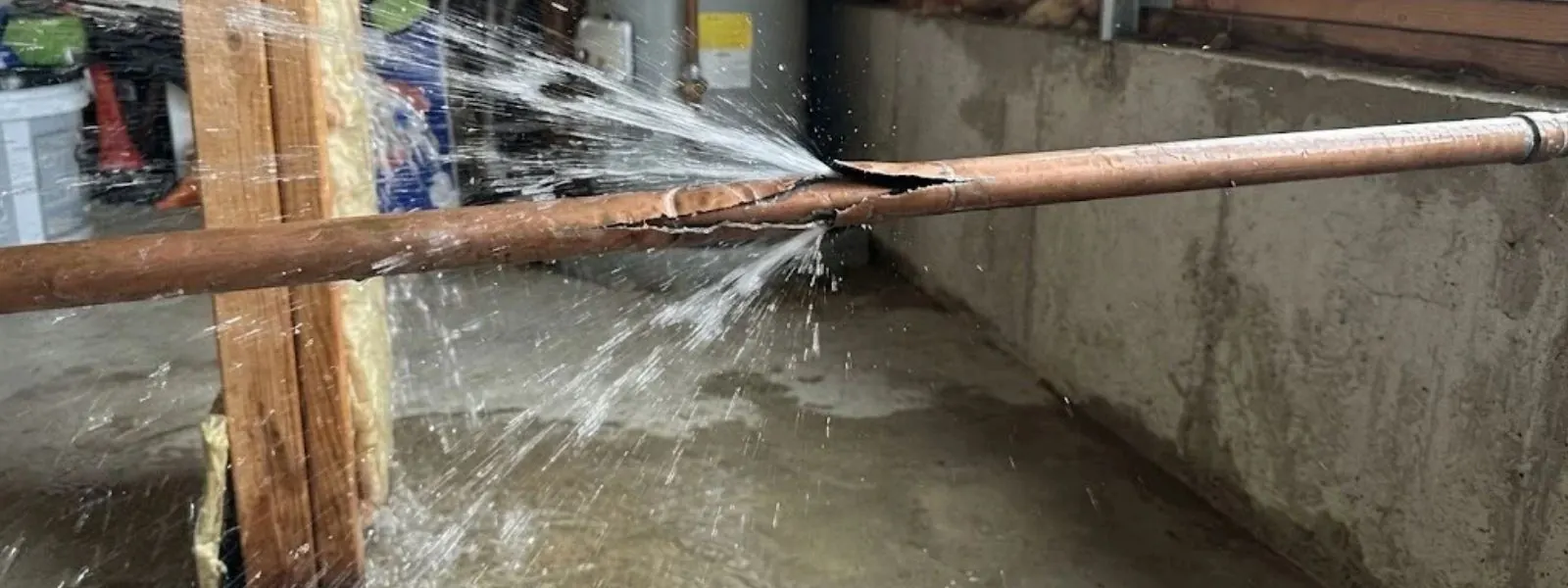
A burst pipe repair call in Romeoville, IL is answered 24/7, including holidays and the coldest nights of the year. Before anything else, stop the water at the main valve. Every minute the pipe runs adds to the damage, and our crew can work on a dry pipe far faster than a live one.
If a pipe has burst right now: shut off the water
- Find the main shutoff, usually in the basement near the meter or where the line enters the house, and turn it clockwise until it stops.
- Open the lowest faucet in the house to drain the lines and relieve pressure.
- Turn off the water heater's power or gas so it does not run dry.
- Shut off electricity to wet areas only if you can reach the panel without standing in water.
- Move furniture and valuables away from the water and take photos for your insurer.
| Shutoff | Typical location | Tip |
|---|---|---|
| Main house valve | Basement wall near the meter, or a utility room | Tag it so everyone in the house knows |
| Curb stop at the street | A buried box near the property line | Usually needs a special key, and the utility owns it |
| Fixture stop valves | Under sinks and behind toilets | Turn clockwise to isolate one fixture |
| Water heater inlet | On the cold line above the tank | Close it if the break is on the heater |
If you cannot find the main valve or it will not turn, say so on the call. Do not force a stuck valve with a wrench. A stripped valve is another repair, and we can close the curb stop through the utility process if needed.
Frozen pipes: thaw safely or wait for us
Never use open flame
Do not use a torch, kerosene heater or propane device on a frozen pipe. Fire and hot spots can ignite framing or crack the pipe. A hair dryer on low or warm towels is safer.
Northern Illinois winters freeze pipes in exterior walls, garages, crawlspaces and unheated utility rooms. If a faucet trickles or gives nothing in a cold snap, a section is probably frozen. Open the faucet, warm the pipe slowly, and watch for leaks as the ice melts. A frozen pipe may already be cracked, and it shows only when thawed.
If you see frost on the pipe, a bulge or any wet drywall, shut the main water off first. Then call before thawing. Thawing a split pipe sends water straight into the wall.
Why pipes crack or split
- Ice expansion inside a freezing pipe, the cause behind most winter bursts
- Corrosion thinning old galvanized or copper walls from the inside
- Pressure spikes from a stuck regulator or water hammer
- Loose fittings and joints that finally give way
- Physical damage from a nail, a remodel or settling
Cracked pipe repair: what we do
Once the water is off, we cut out the damaged section and replace it. In copper we sweat a new length with soldered fittings, and in PEX we use crimp or expansion fittings. A short clamp can hold a pinhole until the full repair is done, but we do not leave one as a permanent fix.
We also check the pipe on either side. Pipes that split in one spot are often weak nearby. If corrosion runs through the whole line, we will tell you, and repiping may be a better plan than patching each failure. The same goes for cracked drain pipes. A damaged drain section gets cut out and replaced, and a camera check finds out how far the damage extends.
Signs a pipe has split or is about to
- A sudden drop in water pressure
- Water stains spreading on a ceiling or wall
- The sound of running water when everything is off
- Frost, a bulge or a bead of water on an exposed pipe
- A wet baseboard or a puddle with no source
- A spinning water meter with fixtures closed
Pipe patched but still dripping?
Describe it to dispatch. A small drip can mean a second failure, and we would rather check than have you wait for a flood.
Call (630) 822-9290After the repair: drying out and paperwork
Water left in drywall and insulation grows mold within a couple of days. Remove wet carpet, run fans and dehumidifiers, and cut out soaked drywall if it sags. Photograph everything before you clean and keep our written repair summary for your insurer.
Sudden pipe bursts are commonly covered under a homeowner policy, while damage from long-term seepage is often not. Read your policy and call your insurer early. If your meter shows a leak but the source is hidden, our leak detection service can trace it.
Codes and permits
Pipe repairs in Illinois follow the Illinois Plumbing Code. Ask the Village of Romeoville building department whether your repair needs a permit, and keep photos of the damage for your insurer.
What changes the price
- Pipe material
- Copper, PEX and galvanized each need different parts and methods.
- Location of the break
- A visible basement pipe is a quick fix. One inside a finished wall needs careful opening.
- Extent of damage
- A single split costs less than a line with several weak spots.
- Drywall and finish work
- We repair the pipe. Patching and painting are usually a separate trade.
- After-hours dispatch
- Night and weekend calls can carry a different rate, and we state it before work starts.
We handle pipe bursts for homes in Bolingbrook and the surrounding area too.
Burst pipe questions from Romeoville homeowners
Yes, every night and weekend. Close the main valve, call the line, and dispatch routes the next free technician to your address.
Look near the water meter and where the pipe enters the house. If it is missing or stuck, tell dispatch. The utility can close the curb stop at the street.
Sometimes, with gentle heat from a hair dryer, if the pipe is not cracked. If you see a bulge, a crack or wet drywall, leave it and call.
Sudden bursts are commonly covered, with exclusions for slow leaks and neglect. Your policy decides, so call your insurer and keep our repair summary.
Not always. If the pipe is old, corroded or has failed in several places, replacing it can cost less over time than repeated patches.
Insulate exposed pipes, seal gaps in exterior walls and garages, and let faucets drip in a hard freeze. Disconnect outdoor hoses before winter.