
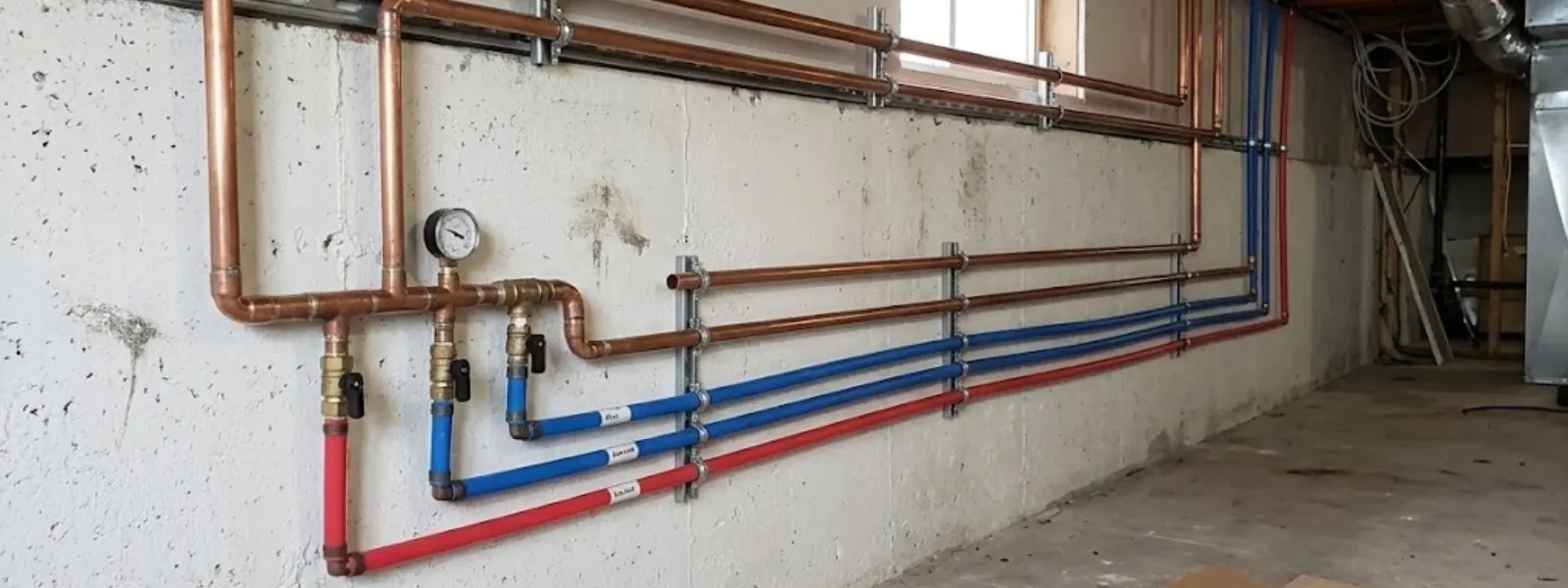
Repiping replaces the supply lines that carry water from the main to every faucet, shower and appliance. It does not touch the drains. If your Romeoville home has galvanized steel, polybutylene or aging copper, replacement may cost less over time than repeated leak repairs and the wall damage that comes with them.
When repiping starts to make sense
Signs your supply pipes may be failing
- Brown or orange water when a faucet has not run for a few hours
- Weak flow at several fixtures, not just one
- Repeated pinhole leaks or green crust on copper joints
- Pipes that clang, shudder or whine
- Water that tastes of metal
- Damp spots on drywall with no obvious source
Pipe materials and what each one means
| Material | Typical problem | Our usual advice |
|---|---|---|
| Galvanized steel | Rust builds inside the pipe, narrowing it and shedding flakes | Plan to replace, because flow keeps dropping |
| Polybutylene (gray plastic) | Known to fail at fittings, sometimes without warning | Replace before it leaks |
| Copper | Pinholes from pitting, or leaks at old solder joints | Spot repair if few leaks, repipe if they keep appearing |
| CPVC | Becomes brittle with age and heat | Inspect, and replace sections that crack |
| PEX | Rarely a problem if fittings are installed correctly | Usually leave it alone |
Replacing galvanized pipe
Galvanized steel was a standard supply pipe in many homes built before the 1960s. It is steel with a zinc coating that wears away, so the inside rusts from the surface outward. The pipe shrinks until water barely trickles, and the rust flakes can foul faucet screens and appliance valves.
You can often spot it at the water meter or at an exposed run in the basement: gray metal with threaded joints, and sometimes a rust-colored bloom at the fittings. If you see that, ask for an inspection before the next leak decides the timing for you.
What age tells you about Romeoville houses
Hampton Park, for example, was developed in 1957, and a house of that era could have galvanized steel, copper or a mix after earlier repairs. Subdivisions built later may have copper, and homes from the 1980s and early 1990s are the group most likely to contain polybutylene. The only way to know is to look at the pipe, which we do on the visit.
How a repipe is carried out
- We inspect the existing lines, test pressure and plan the new route with you.
- The water is shut off and the old supply lines are drained and disconnected.
- New lines go in, usually PEX or copper, through attic, basement or crawl space whenever possible to limit wall openings.
- Every fixture and appliance is reconnected, and the system is pressure-tested for leaks.
- Small access holes are patched or left for a drywall finisher, as agreed in advance.
Water is off for part of each day while we work, so plan for showers and dishes accordingly. We plan the schedule with you in advance. A larger home or an old one with surprises behind the walls may need more days.
PEX or copper
PEX is flexible plastic tubing that bends around corners, so fewer joints and smaller openings are needed. It also resists freezing damage better than rigid metal. Copper lasts for decades and is preferred by some owners for its long record. Either can be correct, and local water chemistry and your budget decide.
Want a pipe inspection before you decide?
Call and tell us what the water looks like and how old the house is. We can book a visit to look at the pipes and talk through the plan.
Call (630) 822-9290What changes the price
- Size of the house
- More bathrooms and longer runs need more pipe and more labor.
- Pipe material chosen
- PEX and copper differ in material price and in how long each takes to install.
- Access to the walls
- An open basement ceiling is quick. Finished walls, tile and plaster add work.
- Repair of the openings
- Drywall patching and painting are not part of plumbing. We tell you what we leave and what a finisher must handle.
- Permits and inspections
- Permit rules vary, so ask the Village of Romeoville building department what applies to your job.
Not every leak means the whole house needs new pipe. If only one wall is wet, leak detection can locate the damaged section, and a failing line outside the home is a job for service line repair. We also install new lines during remodels through our plumbing installation team, and we reach Lockport homeowners to the south.
Repiping questions from Romeoville homeowners
Look at an exposed pipe near the meter or in the basement. Galvanized steel is dull gray, threaded at the joints and attracted to a magnet. Copper is brown or green and a magnet will not stick.
It depends on the size of the house and how easy the walls are to reach. We give you a schedule on the walkthrough, and water is restored at the end of each working day where possible.
Usually not. The water is off for stretches of the day and there is some noise and dust. Many families stay home and plan meals around it.
Pipe lining is mostly used for drains and sewers. For supply lines we replace the pipe, because lining inside small drinking-water lines is rarely appropriate.
It has a record of failing at fittings. Many insurers ask about it, and replacement is generally the safest choice.
It can if the pipes are rusted or clogged. Low pressure can also come from the service line, a pressure regulator or the street supply, so we test before we recommend a replacement.
Yes. If only one bathroom or one floor has failing pipe, a partial repipe is an option, though mixing old and new metals needs care to avoid corrosion at the joints.