
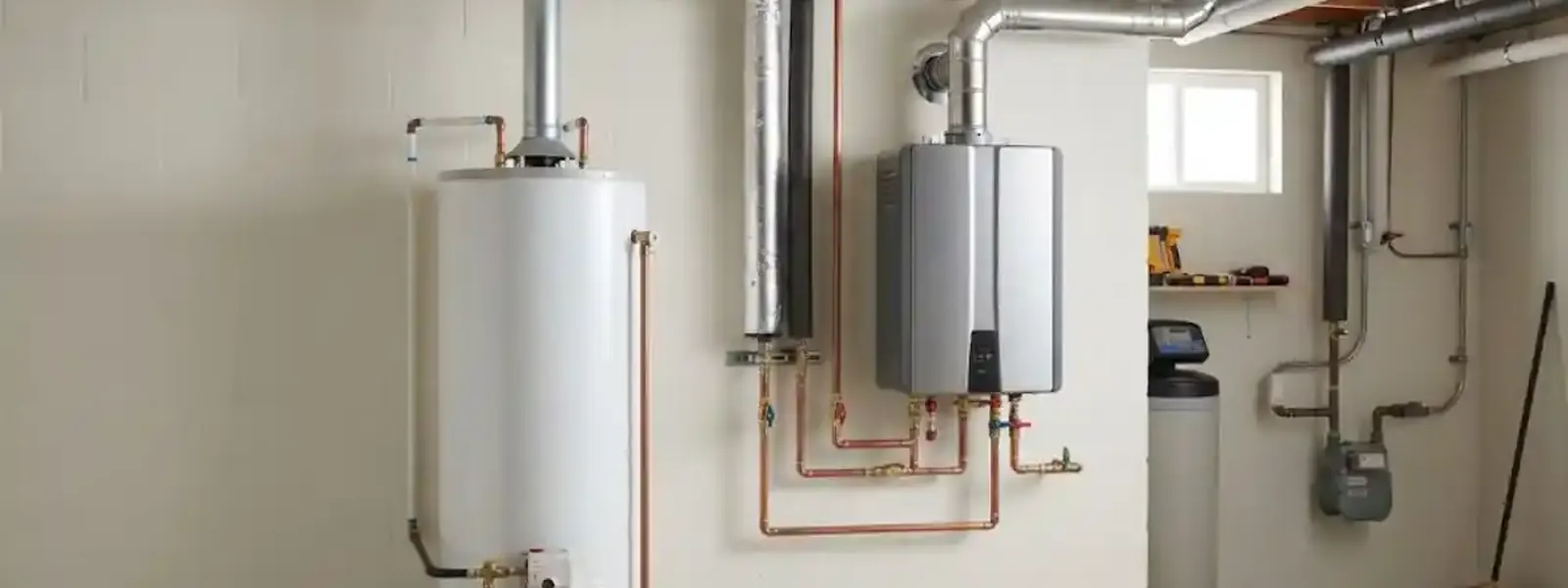
A tankless water heater heats water only when you open a tap, so there is no tank to leak or run out. In Romeoville, IL we install them, repair them and flush them. Some shops only swap them out when they act up. We service them first.
Flushing and descaling a tankless heater
Flushing is the single most useful thing you can do for a tankless unit. Water passes through a narrow heat exchanger. Minerals in that water bake onto the metal as scale, which restricts flow and forces the unit to work harder. Eventually it throws an error code, delivers lukewarm water or shuts down.
We handle the job in a set order. First we shut off gas or power and the water supply. Then we hook up a pump, hoses and a descaling solution to the service valves on the unit. The solution circulates through the heat exchanger and dissolves the scale. Finally we rinse the system, clean the inlet screen and test the unit.
Service valves are essential. If your heater does not have them, we can add a set so future flushes are quick. We also check the vent, the condensate drain on high-efficiency models and the display for stored fault codes.
Signs a tankless heater needs descaling
- Hot water that runs lukewarm or fluctuates between hot and cold
- Error codes tied to flow, temperature or the heat exchanger
- A noticeable drop in flow at the shower
- Rumbling or kettle-like noise from the unit
- Hot water that takes longer to arrive than it used to
How often depends on your water. Ask the Village of Romeoville for its water quality report, or test your tap with a hardness strip. Harder water means more frequent flushing. Your manufacturer's manual sets a minimum interval, and many recommend yearly service in hard-water areas. A softener ahead of the heater cuts the scale at its source.
Is tankless right for your house
| Factor | Tankless | Storage tank |
|---|---|---|
| Hot water supply | Continuous, limited by flow rate | Limited by tank size, then recovery |
| Space | Wall mounted, small footprint | Floor space for a large tank |
| Upfront cost | Higher, often needs new gas line or vent | Lower for a like-for-like swap |
| Upkeep | Regular descaling flushes | Occasional flush and anode check |
| Failure mode | Error codes and reduced flow | Tank leak and flooding |
Tankless units are rated by how many gallons per minute they can heat at a given temperature rise. Winter tap water is colder than summer, so a unit that keeps up in July may struggle in January. We size for the coldest water your supply delivers.
Installing a tankless heater in an existing home
Switching from a tank usually means new venting, since tankless gas units run hot and use sealed stainless or approved plastic vent pipe. The gas line may need upsizing because the burner demands a large burst of fuel. Electric models need heavy circuits, and some homes need a panel upgrade.
We assess all three before quoting. Our installation team handles venting and gas sizing. If an old tank is leaking right now, replacement gets hot water back faster, and a tankless upgrade can follow when you have time to plan.
Error code on the display?
Call with the code and model number. We often know the likely cause before we arrive and book the earliest slot we have.
Call (630) 822-9290Repairs we handle on on-demand units
- Error codes for ignition, flame, flow, exhaust and temperature faults
- Clogged inlet screens and failed flow sensors
- Failed igniters, fans and circuit boards
- Condensate drain blockages on condensing models
- Leaks at service valves and connectors
What changes the price
- Flush only or flush plus repair
- A descaling visit has a set scope. A fault that surfaces during the flush is priced separately and shown to you first.
- Service valves
- A unit without isolation valves needs a set added before it can be flushed.
- Brand and model
- Some manufacturers use proprietary parts that take longer to source.
- Install scope
- New venting, gas upsizing or an electrical upgrade changes the size of an installation.
- Condition of the heat exchanger
- Heavy scale takes longer to dissolve, and a damaged exchanger may mean the unit has reached the end of its life.
We also serve Crest Hill and other towns nearby, and the same crew does flushing, repairs and new installs.
Tankless water heater questions from Romeoville homeowners
Follow your manual, which often says once a year. Hard water can call for more frequent flushing. Test your tap or ask the Village for its water quality report to judge your risk.
Yes. We service and repair gas and electric tankless heaters regardless of who installed them.
Some owners do, if the unit has service valves and they follow the manual. Mistakes with gas, power or the pump can damage the unit, so many choose a plumber.
Codes point to a subsystem such as ignition, flow, exhaust or temperature. Scale is a common cause of flow and temperature codes. The code plus the model tells us where to look.
Usually yes. Gas tankless units need vent pipe rated for hotter exhaust, and the route may differ from your old flue.
Yes. The line is staffed 24/7. If there is no hot water at all or a leak, say so and we prioritize the call.