
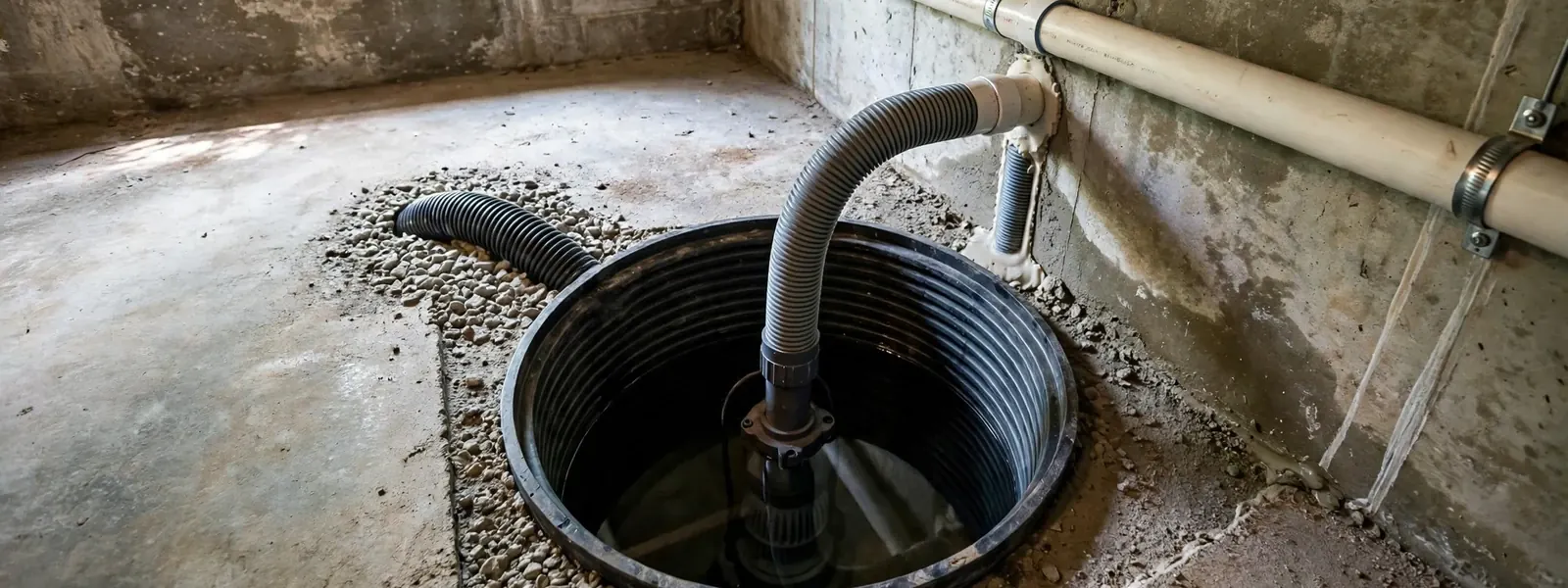
When a sump pump quits, the pit overflows onto the basement floor, and it usually happens in the heaviest rain, when you can least afford it. Most pumps fail for ordinary reasons: no power, a stuck float, a clogged intake or a worn-out motor. You can check the first three in minutes.
Match the symptom to the likely cause
| Symptom | Likely cause | First thing to try |
|---|---|---|
| Pump does nothing, pit fills | No power, tripped GFCI, stuck float or dead motor | Check the outlet and reset the GFCI, then lift the float by hand |
| Pump hums but does not pump | Jammed impeller or a failed capacitor | Unplug it and clear the intake of grit |
| Pump runs constantly | Float stuck up, stuck check valve, or a very high water table | Check the float arm for obstruction and look for backflow when it stops |
| Pump turns on and off every few seconds | Check valve missing or failing, or pit too small | Look for water flowing back down the pipe after each cycle |
| Loud rattling or grinding | Debris in the impeller or worn bearings | Unplug it and inspect the pump base |
| Pump runs but moves little water | Frozen or kinked discharge line, or clogged outlet | Check where the discharge pipe leaves the house |
A safe checklist before you touch anything
- Unplug the pump or switch off its breaker before putting a hand near the pit. Water and electricity do not mix.
- Look at the outlet and the GFCI. Reset it, then plug the pump back in and watch whether the float lifts as water rises.
- Pour a bucket of water into the pit. A working pump should kick on and drain it within a minute or two.
- Lift the float by hand while the pump is plugged in. If the motor starts, the float switch was sticking.
- Check the discharge pipe outside for ice, a crushed section or a closed valve.
- Listen for the check valve. A rush of water back into the pit as the pump stops means the valve is failing.
Do not work in a flooded pit with power on
If water is rising around outlets or cords, leave the basement and shut off the breaker from a dry spot. If you cannot reach the panel safely, call for help instead of wading in.
Common repairs and what they involve
A float switch swap is one of the quickest fixes. A failed check valve is also quick and prevents the short-cycling that wears out the motor. Cleaning silt from the pit helps the pump breathe. When the motor itself has failed, replacing the whole pump is usually more sensible than rebuilding it.
Repair or replace?
- Repair when the pump is relatively new and the fault is a float, valve or cord.
- Replace when the pump is old, rusted, noisy or runs rough after cleaning.
- Replace when it has short-cycled for months, since the motor is likely worn.
- Add a battery backup when the pump is the only protection you have against a flooded finished basement.
Our team handles sump pump repair and new installs, including backup systems that keep running when the power goes out. If water keeps coming despite a healthy pump, the problem is bigger than the pump, and basement waterproofing is the next conversation.
Romeoville note: what a big storm looked like and what the rules are next door
The National Weather Service Chicago office, which is located in Romeoville, recorded 4.12 inches of rain in Romeoville during the record flooding of April 17 and 18, 2013. A pump that handles an ordinary storm may be overwhelmed by a single event like that. For you, it is an argument for a backup power source and a pump sized with room to spare.
Discharge rules are local. The city of Lockport's drainage page says a sump pump should discharge at least 10 feet from the property line, may tie into the public storm sewer only with permit approval, and may not be redirected to the sanitary sewer. Those are Lockport's rules, not Romeoville's. We found no sump pump rule on the Village's site, so ask the Village's Building Department before you reroute a discharge line.
The Village lists the 2014 State of Illinois Plumbing Code as its adopted plumbing code. As a safe habit, keep your sump discharge out of the sanitary sewer in any town, since clean rain water in the sanitary system can overload it during storms.
Pump old, noisy or short-cycling?
Do not wait for the next storm to find out. Call and we will book an inspection and tell you whether to repair or replace.
Call (630) 822-9290Keeping a pump healthy
- Test it every spring and fall by pouring water into the pit.
- Keep the pit clear of gravel, silt and stored items.
- Confirm the discharge line points away from the house and is not frozen or kinked.
- Plug it into a dedicated GFCI outlet, never an extension cord.
- Replace a pump that has been running for most of a decade, even if it still works.
- Install an alarm that sounds when the water level climbs too high.
We take sump pump calls from homeowners in Bolingbrook and Lockport too. The causes of failure are the same in every basement. What differs is how much water each house sees and how long the pump has been running.
Sump pump questions from Romeoville homeowners
The National Weather Service Chicago listing for the April 17 and 18, 2013 event shows 4.12 inches recorded in Romeoville. It is a useful benchmark when you size a pump or decide on a backup.
A high water table, a leaking water line near the pit or a stuck float can all keep it running. If the water is clear and steady, the ground is saturated. If it is a trickle with no rain for days, check for a plumbing leak.
Do not connect clean ground water to the sanitary system without confirming local rules. Cities like Lockport prohibit it outright. In Romeoville, ask the Building Department first.
Many pumps run for roughly seven to ten years, though heavy use shortens that. If yours is that old, plan a replacement before it fails in a storm.
Yes. Big storms often take out power in the same hours the pit needs to drain. A backup pump with its own battery keeps working when the main one cannot.
A burning odor from the motor means it is overheating, and a stale or sulfur smell from the pit means standing water. Unplug the pump if it smells of burning and call.